India: A Civilization of Differences: The Ancient Tradition of Universal Tolerance by Alain Daniélou
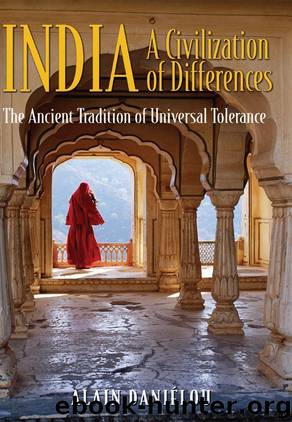
Author:Alain Daniélou [Daniélou, Alain]
Language: eng
Format: azw
Tags: Hinduism/Sociology
ISBN: 9781620550328
Publisher: Inner Traditions/Bear & Company
Published: 2005-07-05T04:00:00+00:00
AHIR LANGUAGE AND TRADITIONS
From a cultural point of view, the Ahirs belong to the same culture as the dark-skinned heroes of the Ramayana and the Mahabharata, Rama and Krishna, referred to by their important orally-transmitted “historical texts.” Krishna, the hero of the Mahabharata, was raised in this community. His love affairs with the cowgirls of Brindavana are famous. Part of the Tamil novel Shilappadikaram,1 dating roughly from the third century C.E., is set in an Ahir village, where the customs are practically the same as in Ahir villages in northern India today. Nowadays, the Ahirs of Benares speak a Hindi dialect that is different from the one used by other castes. Like most popular languages of northern India, its grammatical forms and expressions indicate the existence of an original Dravidian substrate. Their customs, social laws, and rules concerning property and inheritance differ from those of other castes. Polyandry and matriarchy are no longer found, but repudiation and divorce remain easy. Their festivals are peculiar to them and their religion belongs entirely to ancient Shaivism, featuring the phallus cult. It should be noted that, contrary to what is often believed, the lewd festivals, songs, and dances do not imply orgiastic customs or freedom of morals.
Although these peoples are not warriors, they attach great importance to physical exercise and male strength. The women do not take part in the men’s songs and dances. They have their own dances, which are relatively static and are totally different from those of the men. The women’s dances are held on the enormous beaten-earth courtyards of their houses, which persons outside the group may not attend. They are accompanied exclusively by songs and the clapping of hands. The songs as a rule are in praise of the girls’ beauty, assurances of success with a handsome youth, and invocations to the goddess.
Download
This site does not store any files on its server. We only index and link to content provided by other sites. Please contact the content providers to delete copyright contents if any and email us, we'll remove relevant links or contents immediately.
| Anthropology | Archaeology |
| Philosophy | Politics & Government |
| Social Sciences | Sociology |
| Women's Studies |
Born to Run: by Christopher McDougall(7131)
The Leavers by Lisa Ko(6949)
iGen by Jean M. Twenge(5418)
Sapiens by Yuval Noah Harari(5374)
Spare by Prince Harry The Duke of Sussex(5200)
The Kite Runner by Khaled Hosseini(5184)
Machine Learning at Scale with H2O by Gregory Keys | David Whiting(4315)
Bullshit Jobs by David Graeber(4195)
Never by Ken Follett(3960)
Goodbye Paradise(3812)
Livewired by David Eagleman(3776)
Fairy Tale by Stephen King(3401)
A Dictionary of Sociology by Unknown(3086)
Harry Potter 4 - Harry Potter and The Goblet of Fire by J.K.Rowling(3076)
The Social Psychology of Inequality by Unknown(3037)
Will by Will Smith(2928)
The Club by A.L. Brooks(2927)
0041152001443424520 .pdf by Unknown(2849)
People of the Earth: An Introduction to World Prehistory by Dr. Brian Fagan & Nadia Durrani(2739)
